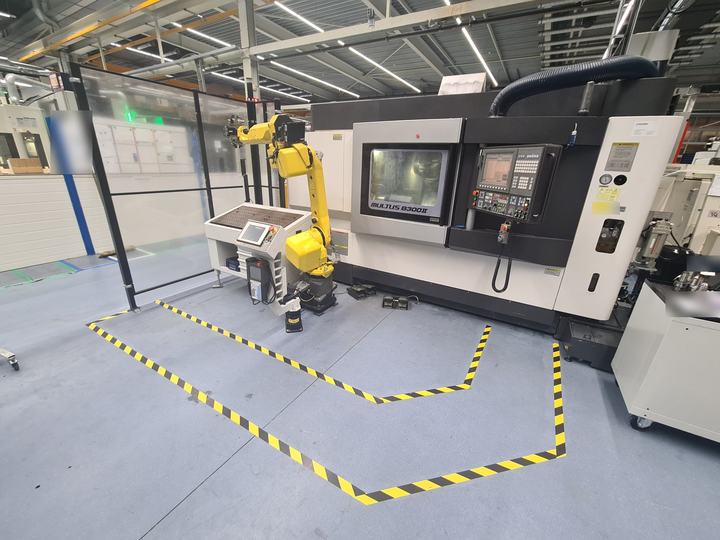
IGS GeboJagema automates two Okuma Multus B300 II machines with RoboJob Turn-Assist
From 40–50 to 80–90 machine hours a week
IGS GeboJagema automates two Okuma Multus B300 II machines with RoboJob Turn-Assist
IGS GeboJagema in Eindhoven, the Netherlands, makes high-precision injection moulds for the medical industry. Since 2015, RoboJob Turn-Assist Essential cells have automated its Okuma Multus B300 II multitasking machines, doubling machine runtime from 40–50 to 80–90 hours a week.
Key facts
- Company: IGS GeboJagema BV
- Location: Eindhoven, North Brabant, the Netherlands
- Founded: 1945
- Employees: approx. 110
- Industries: Pharmaceuticals & Medical
- RoboJob products: Turn-Assist Essential (2×)
- CNC machine brands: Okuma
- Automated machines: Okuma Multus B300 II (2×)
- RoboJob customer since: 2015
- Key results: machine runtime doubled from 40–50 to 80–90 hours a week; fast set-up for series of 15 to 30 parts
From Tilburg toolmaker to medical mould specialist
IGS GeboJagema was founded in 1945 in Tilburg, as a supplier of instruments, tools and stamps (in Dutch: Instrumenten, Gereedschappen en Stempels). Over the years, the company focused entirely on tools and moulds, and then made a strategic choice for the medical market: quality-driven, less price-sensitive and with long product life cycles that favour long-term customer relationships.
The acquisition of HTP Tooling in Eindhoven in 2011 opened new doors. IGS moved to Eindhoven, the two machine parks were combined and completely renewed, and IGS became a supplier to national and international healthcare players. Today, IGS makes moulds for products such as inhalers, insulin pens, diagnostic devices and contact lenses, and serves customers worldwide from Eindhoven and the United States.
A new way of working
IGS achieved strong growth with only two additional employees in production. The rest came from modern machines and automation, and from a new way of working.
“The way of working appears to be the key to success for us. However, you don’t just get there with only a machine park and automation. The employees also have to believe in the story. […] And thanks to automation, the quality of our finished components is so good and so consistent, that we do much more assembly work with the same number of employees as previously. We have thus become significantly more efficient.”
— IGS GeboJagema, Eindhoven
Where IGS once had 12 or 13 different processing operations, it now has four: soft steel manufacturing, hardened component manufacturing, grinding and assembly. The company also works completely paperless.
Why RoboJob: developed on the shop floor
IGS’s director, who started his own career at IGS as a grinder and buys all machines himself, visited RoboJob’s showroom in Heist-op-den-Berg. He quickly saw that the Turn-Assist had been developed on the shop floor. For IGS, it was a conscious choice for workpiece loading.
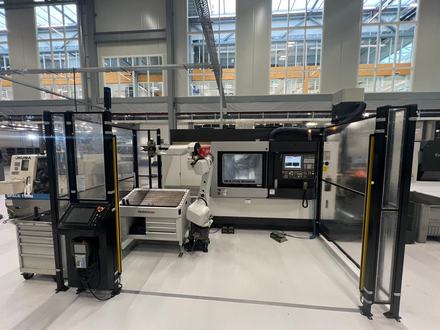
“Using the Turn-Assist Essential we always make series of 15, 20 or up to 30 pieces. The setup time is therefore crucial: RoboJob was able to demonstrate to us that they are by far the best in this.”
— IGS GeboJagema, Eindhoven
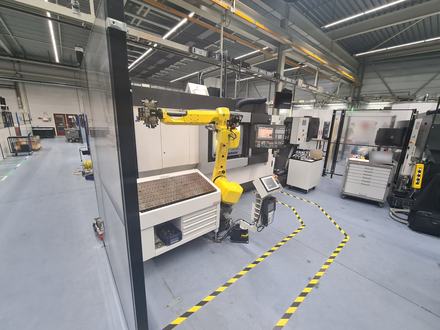
Two Turn-Assists on two Okuma Multus B300 II machines
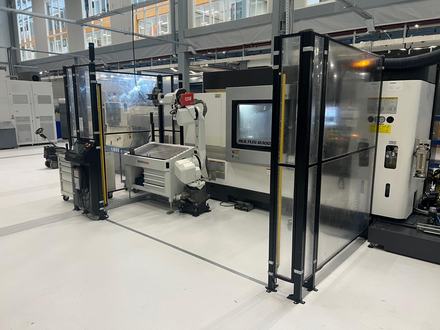
IGS bought an Okuma Multus B300 II multitasking machine, which can turn, mill, drill and engrave. Three employees spent a year learning everything about it. Running manned, it reached 40 to 50 hours a week. After automation with a RoboJob Turn-Assist Essential, it ran 80 to 90 hours a week. A second Multus B300 II with a Turn-Assist Essential followed.
- Okuma Multus B300 II with a Turn-Assist Essential
- Okuma Multus B300 II with a Turn-Assist Essential
The result: twice the machine hours
With RoboJob, IGS doubled the runtime of its Multus B300 II, from 40–50 to 80–90 hours a week. Short set-up times make even series of 15 to 30 parts worthwhile to automate.
Frequently asked questions
Which machines did IGS GeboJagema automate with RoboJob?
IGS GeboJagema in Eindhoven, the Netherlands, automated two Okuma Multus B300 II multitasking machines with RoboJob Turn-Assist Essential cells. The company has been a RoboJob customer since 2015.
Can an Okuma Multus B300 II be automated?
Yes. IGS GeboJagema runs RoboJob Turn-Assist Essential cells on two Okuma Multus B300 II machines. Strautmann Hydraulik runs a Turn-Assist on an Okuma B300W, and Nossin automates two Okuma Multus U 3000 machines. See all Okuma automation projects.
How many extra machine hours can a Turn-Assist deliver?
At IGS GeboJagema, an Okuma Multus B300 II ran 40 to 50 hours a week with an operator. After automation with a RoboJob Turn-Assist Essential, it ran 80 to 90 hours a week.
Is automation worthwhile for small series?
Yes, if set-up is fast. IGS GeboJagema automates series of 15 to 30 parts on its Okuma Multus B300 II machines; short RoboJob set-up times make that worthwhile.
Which medical suppliers use RoboJob automation?
RoboJob automates CNC machines at suppliers to the medical industry such as IGS GeboJagema in Eindhoven, Van Trierum Metaalbewerking and Nossin in the Netherlands, and Meca Technic in France. See CNC automation for medical and pharma parts.