Workpiece loading or pallet loading?
Should you choose workpiece loading or pallet loading for your milling machine?
Automating CNC machines has become a must these days. After all, there is an urgent need for machine capacity and a major shortage of technical personnel everywhere. CNC Automation can provide a solution to these and many other challenges we face today. When automating milling machines, we are often asked whether it is best to load and unload workpieces, or rather to load pallets or exchange clamping units.
Detlef Scholz is the Sales Manager at RoboJob in the DACH region (Germany, Austria and Switzerland). He works mainly in southern Germany, but is also active in Switzerland and parts of Austria. "A lot of machining is done in this region, especially milling," says Scholz. "After all, this is where the heart of the German automotive industry is located, as well as precision mechanics and tool mechanics (ed. Hainbuch, Schunk, EWS, Eppinger, Heimatec). Machine manufacturers such as Hermle, Mazak, Hurco and DMG sell hundreds of milling machines here every year to customers who are also in the process of automating."
Detlef Scholz - Sales Manager DACH

"When I sit down with these companies, I am invariably asked 'What is the best option? Manually clamping multiple pallets and having them loaded by the robot, or having the workpieces loaded individually in the clamping unit in the machine? Many customers have been working in the same way for years and are happy to stick with it," says Scholz. "Companies such as Lang, HWR and Indunorm have established a good foothold here and have won over the customers with their products. It would be difficult to make inroads there. When you want to automate, however, it is important to challenge your current way of working and examine your processes with an open mind."
Why do many companies still clamp pallets manually?
Many customers have been working in the same way for years and are happy to stick with it.
An operator will often want to manually clamp a workpiece into a pallet and start machining it. After all, this is the way it has always been done: the operator has confidence in this way of working and, at first glance, this is also the most economical way to do it. There are also solutions available, of course, that allow you to clamp two or three workpieces in a single clamping unit. You can also choose from clamping pyramids, a pallet with four workpieces or a clamping bridge with six workpieces. There are even pallet changing systems that can accommodate up to two times twelve workpieces!
What are the disadvantages of pallet loading?
That is all great, but this way of working also has some major disadvantages:
- Time: manually clamping the workpieces in the pallet and exchanging the workpieces in the pallets takes a lot of time. When you have a shortage of personnel, that becomes a major problem.
- Space: I don't know many customers who don't have a lack of space on the shop floor. This way of working also requires extra space.
- Money: every pallet costs money. The more you want to put in, the more expensive it gets. If you think you can work more efficiently with multiple pallets, you will of course spend even more money.
Why is workpiece loading often more efficient than pallet loading?
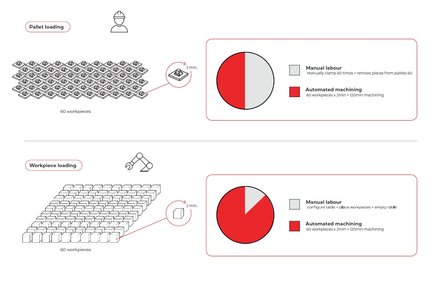
Workpiece loading can be considerably more interesting than pallet loading. Let me give you two concrete examples:
Example 1: pallet loading
I have a batch of 60 pieces with an individual cycle time of 2 minutes. Suppose I have a warehouse with 60 pallets: I can run my machine autonomously for 120 minutes. First I have to manually clamp 60 times, and after 2 hours I have to take all 60 pieces out of the pallets again. This means that for 2 hours of autonomous machining, at least 1 hour of manual work is required.
Example 2: workpiece loading
Now I take the same batch of 60 pieces with an individual cycle time of 2 minutes, but this time I place them on my Mill-Assist, from where the robot loads them into the machine one by one. Configuring the table and placing the workpieces takes me a maximum of 10 minutes. Clearing the table might take another 5 minutes. This means that for 2 hours of autonomous machining, I only need to do 15 minutes of manual work. Moreover, I don't need to buy 60 pallets.
Which loading method is best for your batch production?
When you want to automate, it is important to challenge your current way of working and examine your processes with an open mind.
"After all, when you want to automate, the idea is to make your production more efficient, right? Taking repetitive, boring work out of the hands of your operator should allow them to be more creative. Well, in my experience, for this type of batch work you should always be able to rely on a robot that loads and unloads the individual workpieces. This improves efficiency, is reliable, faster and cheaper."
Not sure which automation solution suits your milling machine and workpieces? Answer a few questions and we'll help you choose.
Frequently asked questions about workpiece loading and pallet loading
What is the difference between workpiece loading and pallet loading?
With pallet loading, an operator manually clamps workpieces on pallets and the robot exchanges the pallets in the machine. With workpiece loading, the robot loads and unloads the individual workpieces directly into the clamping unit of the CNC machine.
Is workpiece loading or pallet loading better for batch production?
For batch work, workpiece loading is often more efficient. In RoboJob's example of 60 pieces with a 2-minute cycle time, pallet loading requires at least 1 hour of manual work for 2 hours of autonomous machining, while workpiece loading requires only about 15 minutes.
What are the disadvantages of pallet loading for CNC milling?
Pallet loading costs time, because workpieces have to be clamped and exchanged manually; space, because pallets need room on the shop floor; and money, because every extra pallet adds cost.
Which RoboJob system loads individual workpieces into a milling machine?
The Mill-Assist lets a robot load individual workpieces into your milling machine one by one from a configurable table.
How do I choose the right automation for my milling machine?
Use RoboJob's Help me choose tool or request a demo, and our specialists will advise you based on your machines, workpieces and batch sizes.