The most important difference between a robot and a cobot
What is the most important difference between a robot and a cobot?
In December 2023, we conducted a poll on LinkedIn about the differences between a robot and a cobot. Our R&D specialist Seppe Verstraeten walks you through the results.
Payload, safety, price or installation time?
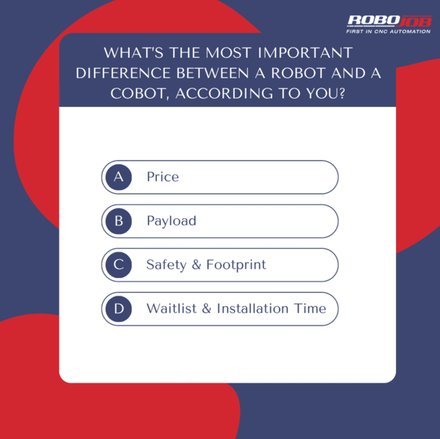
The most important difference between a cobot and a robot is the payload. That's what our panel of experts decided in our first poll on LinkedIn. This answer received 50% of the votes. The very close runner-up was safety (46%), third was price (4%) and last was waiting & installation time, with 0% of the votes. Here's why:
1. Payload
Payload is the winner of our poll, with 50% of the votes. The majority of voters chose payload as the most important difference between a robot and a cobot, as there's simply no comparison between a robot that can handle workpieces of up to 165 kg and a cobot that handles 10 kg. After all, it's your workpieces that dictate your needs.
It's only logical that companies avoid disproportionate investments by selecting a robot or cobot that carries exactly the payload they need. So it shouldn't be a surprise that payload is the most important difference between a cobot and a robot according to our respondents.
2. Safety & footprint
Safety and footprint ended second, with one vote less than payload. There's no better way to tell a cobot and a robot apart than by their safety and their ability to collaborate with the operator. Industrial robots are scared of humans: they slow down and eventually freeze completely when someone approaches.
Cobots are more like dogs: they like it when you're around, and they will hold still if you pet them. Being able to come closer gives you more freedom to work alongside the cobot, opening many doors for smart collaboration.
These pettable robots are currently built to work with lightweight workpieces, and safety is integrated in the arm by means of force sensors. In comparison to conventional robots, cobots don't need extra safety devices to prevent harm to operators or equipment. Watch this 26-second video to see how accurately the safety detection system of a cobot works.
Footprint is gaining importance as machine halls are bursting at the seams. And it's not just the size of the machines, it's their extensive safety and slow-down zones as well. If you work with lightweight workpieces, you can save a lot of space by choosing a compact solution like a cobot.
3. Price
We were surprised to see that only one courageous soul indicated that price was the most important factor when choosing between a robot and a cobot. OK, the cobot itself might be a little more expensive than a robot with the same payload, but it doesn't have any hidden safety costs. The total cost of ownership of a cobot is lower than that of a robot, as the safety mechanisms are inherent to the cobot, so there's no need to invest in external safety measures such as sensors or fencing.
It's a strong signal that only one respondent acknowledged this for now. We bet that if we were to relaunch this poll in a few years, the answer price would definitely be more popular.
By the way, did you know that market researchers estimate that the cobot market will exceed 100 billion dollars by 2043, with over 4 million installations per year? We're curious to see where this goes.
4. Waiting & installation time
It was either not relevant as an answer, or it just didn't resonate with our sample audience. That's nice to hear, as it's hard to speed up an installation waiting list. Luckily, DIY cobots are on the rise.
And what's not to like: an automation system that you can configure yourself, with the assistance of an extensive video tutorial library. Hello, future!
Thank you to everyone who voted!
This was the first blog in our series Go to the Polls.
Blog 1: The most important difference between a robot and a cobot
Blog 2: This is the favourite event type of CNC experts
Blog 3: CNC experts prefer this measuring method for their automated manufacturing process
Robot or cobot: which one fits your production?
Not sure whether a robot or a cobot suits your workpieces best? Answer a few questions and we'll help you choose.
Do you have a topic in mind to ask our robot community? We'd love to hear from you! Don't hesitate to email us at info@robojob.eu.
Frequently asked questions about robots and cobots
What is the most important difference between a robot and a cobot?
According to RoboJob's LinkedIn poll among CNC experts in December 2023, payload is the most important difference, with 50% of the votes. A robot can handle workpieces of up to 165 kg, while a cobot handles around 10 kg.
Is a cobot safer than an industrial robot?
A cobot has safety integrated in the arm by means of force sensors, so it can work alongside the operator without extra safety devices. Industrial robots slow down and eventually stop when someone approaches, and usually need external safety measures.
Does a cobot take up less floor space than a robot?
Yes, in many cases. A cobot is compact and does not need extensive safety and slow-down zones, so if you work with lightweight workpieces you can save a lot of floor space.
Is a cobot more expensive than a robot?
The cobot itself can be a little more expensive than a robot with the same payload, but it has no hidden safety costs. Because no external sensors or fencing are needed, the total cost of ownership of a cobot is lower.
Does RoboJob offer a cobot for CNC machines?
Yes. Coby CNC is RoboJob's cobot solution for loading and unloading CNC machines of any brand, designed for small and lightweight batches. Not sure which solution fits your workpieces? Use our Help me choose tool.