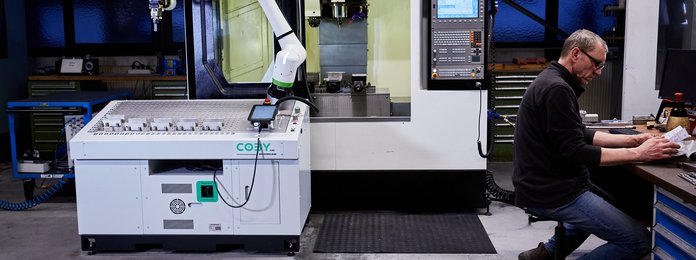
Robot or Cobot: which one is right for me?
What is the difference between an industrial robot and a cobot, and which one suits your CNC production?
The manufacturing industry is a hybrid environment where people and machines work alongside each other. Whether we’re talking about a small metal-cutting workshop or a full-scale machine manufacturer, robots are there to make our lives easier. Tasks that are repetitive, risky or physically demanding are better left to the experts made from bytes and bolts. But how does a conventional industrial robot compare to a CNC cobot? And where does the difference lie? Let’s take a closer look.
What is the difference between an industrial robot and a cobot?
The basic difference between industrial robots and CNC cobots is that robots are designed to do work instead of humans, while cobots are designed to function alongside humans. Cobots, or ‘collaborative robots’, are there to assist your automation, not to enforce it.
The main role of cobots is to support workers by taking over tasks that are dangerous, hard or tedious. On top of the obvious rise in efficiency, quality and safety of the manufacturing process, cobots can free up time for operators to enjoy the more rewarding or creative side of their job.
The role and objectives of conventional industrial robots are largely the same, yet they usually operate on a much larger scale: higher speed, higher accuracy, higher payload.
But that comes at a price.
How do robots and cobots compare?
Fixed vs flexible
Industrial robots are fixed, as they are dedicated to a specific part of the production process. They can be moved around but are not designed to do so very easily, and are therefore often stationed in the same spot for their entire lifetime.
Cobots, on the other hand, can be moved around more freely because of their compact size, low weight and lack of hard-wiring, so they can take on different tasks as needed. They are designed to be versatile and adaptive to any environment, whether it’s a change in the product line, workforce or workspace. Naturally, a collection of cobots, each taking on a specific task, would deliver the best results.
Complexity vs simplicity
Most industrial robots require considerable technical skills and knowledge to set up. CNC cobots can be deployed a lot faster than industrial robots and don’t require any technical training to operate or set up. They learn quickly and can be repurposed in seconds just by moving the arm or pressing a few buttons. Child’s play, really.
RoboJob’s industrial robot systems for turning and milling, such as the Turn-Assist and Mill-Assist, run on the same user-friendly software as its Coby CNC cobot. That makes for a quick, easy setup and changeover that does not require prior experience.
High vs low payload
One of the major differences between robots and cobots is payload: the amount of weight the robot arm is capable of lifting. In general, the payload of cobots ranges from 3 to 20 kg (6 to 45 lbs), while heavy-duty industrial robots, like the ones used in the car industry, can carry up to 1,000 kg (2,200 lbs).
The advantage of low-payload cobots is that they are capable of a wide range of motion (six degrees of freedom) without carrying major size or mass. They can perform a multitude of tasks like assembly, welding or pick and place, with the ability to work with parts that might be too small or delicate for human handling.
High vs low cost
Obviously, the cost of an industrial robot is much higher because it operates on a larger scale than a cobot. But other factors, like a more complex system integration or the need for skilled operators, come into play as well. Although their ROI may be higher in the long run, industrial robots require a considerable initial investment.
Cobots are competitively priced, at almost half the price of an industrial robot, which minimises upfront costs. Their ROI is much faster thanks to speedy integration and general ease of use. In other words: low risk, high reward.
Safety risks
Because of their size and operating speed, industrial robots are often caged or equipped with motion or light sensors to keep humans out of their workspace. Without extensive safety measures, accidents could be serious or even fatal. Cobots, however, do not require a cage or other types of safety infrastructure, since they are meant to work alongside humans. Cobots are force-limited and therefore inherently incapable of causing serious harm, though basic risk assessments still apply.
Robot or cobot: which one is right for me?
Thanks to its flexibility, ease of use, cost-effectiveness and fast ROI, cobot automation is ideal for small and medium-sized businesses that require high-mix, low-volume production. Depending on the need, cobots can be repurposed in minutes, taking on any kind of job in a hybrid workforce. More importantly, cobots improve the production process without taking away the jobs and joy of human workers.
Frequently asked questions about robots and cobots
What is the main difference between an industrial robot and a cobot?
An industrial robot is designed to do work instead of humans, often on a large scale with high speed and payload. A cobot, or collaborative robot, is designed to work alongside humans and take over tasks that are dangerous, hard or tedious.
How much weight can a cobot lift?
In general, cobots have a payload of 3 to 20 kg (6 to 45 lbs). Heavy-duty industrial robots, like those in the car industry, can carry up to 1,000 kg (2,200 lbs).
Is a cobot cheaper than an industrial robot?
Yes. A cobot costs almost half the price of an industrial robot, and its ROI is faster thanks to quick integration and ease of use. Industrial robots require a considerably larger initial investment. Want to know what automation would mean for you? Request an ROI calculation.
Does a cobot need a safety cage?
No. Cobots are force-limited and meant to work alongside humans, so they do not require a cage or other safety infrastructure. Basic risk assessments still apply. Industrial robots, by contrast, are often caged or equipped with motion or light sensors.
Should a small CNC business choose a robot or a cobot?
For small and medium-sized businesses with high-mix, low-volume production, a cobot is often ideal thanks to its flexibility, ease of use and fast ROI. Not sure which solution fits your machines? Use RoboJob’s Help me choose tool.