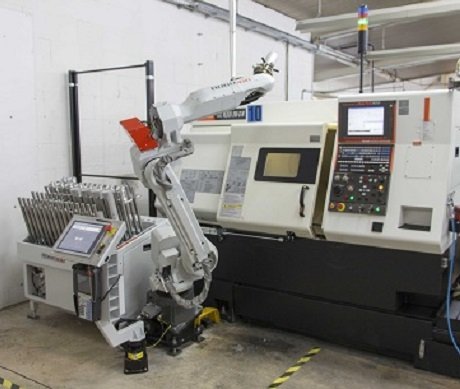
Hetschel automates a Mazak Integrex J-200S with a RoboJob Turn-Assist 250
Installed in three days, running unmanned on day four
Hetschel automates a Mazak Integrex J-200S with a RoboJob Turn-Assist 250
Hetschel, the company behind Mach1 Kart in Brackenheim-Meimsheim near Heilbronn, Germany, builds racing karts and machines small series and prototypes for car and machine tool makers. Since 2016, a RoboJob Turn-Assist 250 has automated its Mazak production. The first cell was installed in three days and ran unmanned on day four.
Key facts
- Company: Hetschel GmbH & Co. KG (Mach1 Kart)
- Location: Brackenheim-Meimsheim, near Heilbronn, Baden-Württemberg, Germany
- Founded: 1969
- Employees: approx. 12
- Industries: Machine construction, Automotive
- RoboJob products: Turn-Assist 250
- CNC machine brands: Mazak
- Automated machines: Mazak Integrex J-200S
- RoboJob customer since: 2016
- Key results: installed in three days, running unmanned on day four; more output with the same team
Racing karts and precision parts from Meimsheim
Brothers Lothar and Wilhelm Hetschel started building karts in 1968 in their father’s basement in Stuttgart-Zuffenhausen; the company was founded in 1969. Wilhelm Hetschel won several German titles and, in 1972, the European championship on a Mach1 kart. Since the 1970s, Hetschel has been based in Brackenheim-Meimsheim, where several hundred Mach1 karts and almost all their parts are made each year on around 5,000 m². Besides motorsport, Hetschel develops and produces parts and tools in small series and prototypes for well-known car and machine tool manufacturers.
Why automate: more output, a humane workload
With 11 CNC machines, each operator served almost two machines. The workload was high, and that is where automation had to make a difference.
“For some time now, my brother and I have been saying that we should automate in order to get more output from our machines, whilst also keeping the workload humane for our operators.”
— Martin Hetschel, Managing Director, Hetschel
Hetschel had even considered buying a robot and programming it in-house, but there was no standard solution. Until the brothers came across a RoboJob video on YouTube.
Found on YouTube, convinced by the references
The compactness of the RoboJob cells stood out immediately. Hetschel contacted RoboJob, met with its sales team several times, visited RoboJob customers in the region and compared other suppliers. None could match what RoboJob offered, and the other RoboJob users in the region convinced Hetschel to go ahead.
A Turn-Assist 250 on a Mazak Integrex J-200S
The RoboJob Turn-Assist 250 was Hetschel’s first automation apart from a bar loader. Today it loads and unloads a Mazak Integrex J-200S multitasking machine.
The operators were somewhat sceptical at first, but are now enthusiastic. Hetschel communicated clearly that this step was necessary to survive and grow, and RoboJob met every expectation.
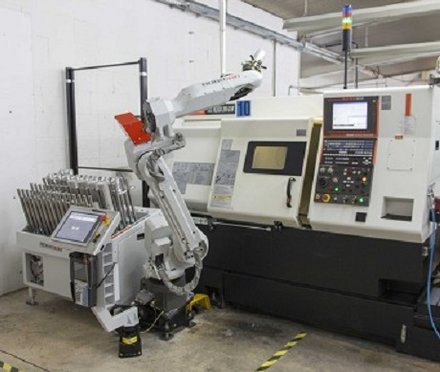
The result: unmanned from day four
“We had NEVER expected that our Turn-Assist could be installed in just 3 days and that we could then get to work unmanned and independently on day 4. This really blew the socks off us.”
— Martin Hetschel
The goal is clear: more output from the CNC machines with the same team, because skilled people are hard to find.
Frequently asked questions
Which machine did Hetschel automate with RoboJob?
Hetschel in Brackenheim-Meimsheim, Germany, the company behind Mach1 Kart, automated a Mazak Integrex J-200S with a RoboJob Turn-Assist 250. The company has been a RoboJob customer since 2016.
Can a Mazak Integrex J-200S be automated?
Yes. Hetschel runs a RoboJob Turn-Assist 250 on a Mazak Integrex J-200S. Aelbrecht-Maes Metaalconstructies also automates an Integrex J200S, and Torson and Vanro CNC run Turn-Assists on Integrex J200 machines. See all Mazak automation projects.
How quickly can a RoboJob Turn-Assist be up and running?
At Hetschel, the Turn-Assist was installed in three days and ran unmanned on day four. Buyse Metal Works Group had a similar experience: anchored on Monday, installed on Tuesday, operators trained on Wednesday.
Is a single robot cell a good first step into automation?
For Hetschel, the Turn-Assist was its first automation apart from a bar loader, a pilot to learn from. It met every expectation, and operators who were sceptical at first became enthusiastic. Lemmens Metaalbewerking took a similar first step with a Turn-Assist 180.
How did Hetschel find RoboJob?
By chance, through a RoboJob video on YouTube. The compactness of the cells stood out. Hetschel then met RoboJob’s sales team, visited RoboJob customers in its region and compared other suppliers before choosing RoboJob.