Ergonomics as a reason to automate CNC loading
How does automated CNC loading make the workplace more ergonomic?
Let’s do the maths. A batch of 300 items, each weighing 8 kg. Each item goes into the machine once and comes out once. That’s 600 lifting movements, totalling 4,800 kg that your operator moves in a single shift. The same again tomorrow. And the day after tomorrow too.
Nobody complains after one day. But they do after ten years.
At RoboJob, we come from a machining background. We’ve been automating CNC machines since 2007 and have now built more than 2,000 systems. In the past, we mainly heard “we want more spindle hours”. Today, we’re increasingly hearing a second reason: "We want to get the best out of our staff, without their backs paying the price."
In this article, you’ll find out where the physical strain lies in your workshop, why it’s a business risk, and how automation can eliminate that strain.
What does ergonomics mean in the workplace?
Ergonomics is about work that fits the human body: the right working height, limited loads and as few repetitive, straining movements as possible. In a CNC workshop, it mainly comes down to one thing: how often and how much weight your operator lifts, and how often they reach and bend.
Why a lifting aid or an extra colleague doesn't solve the problem
The reflex is understandable: install a lifting device, or spread the work over more people. But:
- A lifting aid shifts the problem. The part weighs less, but the operator still stands next to the machine, part after part.
- Extra people simply aren't available. Aelbrecht-Maes automated partly because good operators were becoming harder and harder to find. The same goes for most workshops.
- Repetition is still repetition. Even light parts become a strain when they require the same movement hundreds of times a day.
The problem isn’t the weight of a single item. It’s the sum of all the items.
Where the physical strain lies in manual CNC loading
Musculoskeletal complaints are among the most common work-related health problems. They are rarely the result of a single instance of heavy lifting, but rather of years of repetitive strain.
In the workshop, that strain comes from three sources:
- Lifting: raw parts and finished components in and out of the machine, changing fixtures.
- Reaching and bending: taking parts from a pallet at floor level or placing them deep inside the machine.
- Repetition: the same movement, all shift long.
For an employer, that means experienced people leaving earlier and a job that looks less attractive to young technicians.
So automation isn't just a production decision. It's prevention, too.
More ergonomic work with automated CNC loading
Automation doesn't take the operator away from the machine. It takes them away from loading and unloading hundreds of times per shift. The robot loads and unloads. Your operator plans, programs and checks.
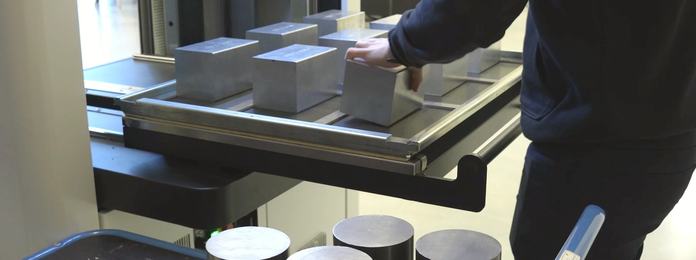
Let's be honest: with a Tower, your operator still places the parts in the trays and takes them out again. So the weight doesn't disappear. What does change is how they lift: at the pass-through hatch instead of deep inside the machine, in one go instead of spread across the whole shift, and without time pressure, because the robot keeps working in the meantime. Want to get rid of that lifting too? Then Pallet-Load takes the parts straight from the pallet.
In the video below, you can see an operator loading the Tower EVO.
Tower EVO
The Tower stores raw parts, fixtures and tools in trays. With the Tower EVO, the operator loads and unloads via a smart pass-through hatch, safely and ergonomically, without complex guarding or light curtains. Read how we gave the Tower EVO 40% more capacity in a more compact design.
While the robot keeps working, the operator loads and unloads trays via the lift. The robot doesn't have to wait. The Tower EVO uses the EGrip71 servo gripper, developed entirely by RoboJob. It changes gripper fingers automatically. The new Tower and the EGrip71 premiered at EMO Hannover 2025.
Pallet-Load
Do your parts arrive on pallets? With Pallet-Load, the robot takes them straight from the pallet. Bending and reaching for the bottom layer become a thing of the past.
Other solutions
Working mainly with lathes or milling machines? Then Turn-Assist and Mill-Assist load and unload your machine automatically. For central storage of tools, fixtures and raw materials, there's the Wall.
What automation changed for our customers
These customers didn't automate primarily for ergonomics. But their stories show what changes for the people on the shop floor.
Biezepol Metaalbewerking uses the first Pallet-Load Integrated at a customer site. Using vision and AI, the system loads a Mazak QT 350 MSY directly from standard wooden pallets. The robot takes the parts from the pallet, not the operator.
Four steps to a more ergonomic workplace
- Map the lifting moments. Which machines require the most loading and unloading?
- Weigh and count. How heavy are the parts, and how many per shift?
- Talk to your operators. They know exactly which tasks weigh heaviest.
- Choose the right solution. Tower, Wall, Pallet-Load, Turn-Assist, Mill-Assist or Coby CNC, depending on your product mix.
Conclusion: let the robot do the lifting
Ergonomics is no longer a soft factor. It determines how long your experienced people stay, how attractive your workshop is to new talent and how much you lose to absenteeism. Automation solves this without bringing your production to a halt. Quite the opposite.
Want to see what that looks like in practice?
FAQs
1. Why is ergonomics important in a CNC workshop?
Because loading and unloading involves a lot of repetitive lifting. Musculoskeletal complaints are among the most commonly reported work-related health complaints.
2. How does automation improve ergonomics?
The robot takes over loading and unloading the machine. The operator prepares the parts at the pass-through hatch, without time pressure, and focuses on planning and quality.
3. How many parts can the Tower EVO hold?
Depending on the height, up to 29 trays and up to 13.9 m² of storage. Each tray can hold raw materials, fixtures or tools.
4. Which solution suits small, light parts?
Coby CNC, a cobot with a 10 kg payload for small batches with many different products.
5. Does RoboJob work with every brand of CNC machine?
Yes. Our systems integrate with new and existing CNC machines, regardless of brand.