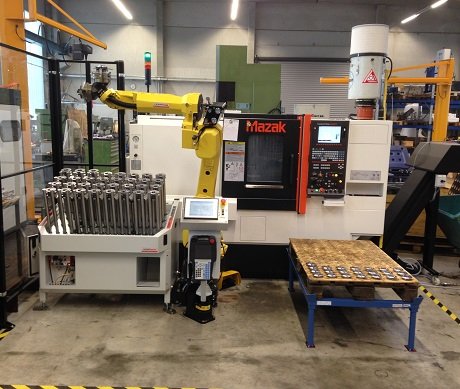
NEXTec+ Fertigungstechnik runs three Mazak QTN 250 lathes with RoboJob Turn-Assist
From 16 to 20 production hours a day, with 25% of orders unmanned
NEXTec+ Fertigungstechnik runs three Mazak QTN 250 lathes with RoboJob Turn-Assist
NEXTec+ Fertigungstechnik, a subcontractor from Monschau, Germany, runs three Mazak QTN 250 lathes with near-identical RoboJob Turn-Assist cells. Since 2013, automation has raised production from 16 to 20 hours a day, with 25% of orders now produced unmanned, and has even brought orders back from China.
Key facts
- Company: NEXTec+ Fertigungstechnik GmbH
- Location: Monschau, North Rhine-Westphalia, Germany
- Founded: 2003
- Employees: approx. 15
- Industries: Subcontracting
- RoboJob products: Turn-Assist 250 (3×)
- CNC machine brands: Mazak
- Automated machines: Mazak QTN 250 (3×, near-identical cells)
- RoboJob customer since: 2013
- Key results: 20 instead of 16 production hours a day; 25% of orders produced unmanned; orders won back from China
A subcontractor competing internationally
Since 2003, NEXTec+ Fertigungstechnik has supplied international companies from Sweden to France from its base in Monschau, in the Eifel region near Aachen. In that market, the competition is stiff, not least from Chinese suppliers with very competitive prices. To keep orders, and jobs, in its own region, NEXTec+ committed to automation.
“In order to provide our international clients with the best possible service, we must not only offer competitive market prices and fast delivery, but also give added value. And that can only be done with automation. Without automation, we would fail to produce the required quantities (up to 40,000 units per year).”
— Manfred Peters, Managing Director, NEXTec+ Fertigungstechnik
A loyal Mazak user
NEXTec+ has worked with Mazak for years: its machine park consists of four machining centres and five lathes, all from Mazak. The company got to know RoboJob through its contact at Mazak, who told them about the possibilities of automation.
Three Turn-Assists on three Mazak QTN 250s
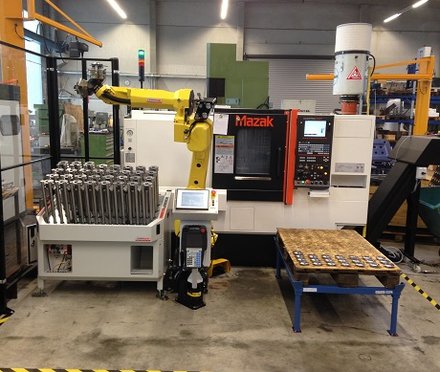
The first RoboJob Turn-Assist 250 went into service in 2013 on a Mazak QTN 250. Two more followed, each on a Mazak QTN 250, so NEXTec+ now runs three near-identical cells. Every installation went flawlessly, and the operators were convinced right away.
The result: 20 production hours a day
NEXTec+ works in two shifts, which used to mean about 16 production hours a day. With the RoboJob automation, the Mazak QTN 250s now run 20 hours a day.
“Using the machines with RoboJob automation we even manage 20 hours per day. This way we produce 25% of our orders unmanned and thus utilize much more of the machine capacity.”
— Manfred Peters
The higher output has made NEXTec+ more competitive, to the point that orders have come back from China.
Frequently asked questions
Which machines did NEXTec+ Fertigungstechnik automate with RoboJob?
NEXTec+ Fertigungstechnik in Monschau, Germany, runs three near-identical RoboJob Turn-Assist 250 cells on three Mazak QTN 250 lathes. The company has been a RoboJob customer since 2013.
Which supplier can automate a Mazak QTN 250?
RoboJob automates the Mazak Quick Turn Nexus 250 with its Turn-Assist. NEXTec+ Fertigungstechnik runs three such cells, Mitsubishi Chemical Advanced Materials in Belgium runs one, and POK also automates Mazak Quick Turn Nexus 250 lathes with RoboJob. See all Mazak automation projects.
How many extra production hours can lathe automation deliver?
At NEXTec+ Fertigungstechnik, working in two shifts used to mean about 16 production hours a day. With RoboJob Turn-Assist cells on its Mazak QTN 250 lathes, the machines now run 20 hours a day, and 25% of orders are produced unmanned.
Can automation help European subcontractors compete with low-cost countries?
For NEXTec+ Fertigungstechnik, yes. Facing competition from Chinese suppliers, the company automated three Mazak QTN 250 lathes with RoboJob. The higher output made it competitive enough to win orders back from China.
Why do companies add a second and third RoboJob cell?
At NEXTec+ Fertigungstechnik, the first Turn-Assist on a Mazak QTN 250 delivered such results that two near-identical cells followed.