Ackermann Metallwaren automates two Mazak lathes with RoboJob Turn-Assist 180
RoboJob’s first customer in Germany: 15 to 30% more spindle hours
Ackermann Metallwaren automates two Mazak lathes with RoboJob Turn-Assist 180
Ackermann Metallwaren in Plettenberg, Germany, makes hose fittings and screw connections. In 2013, it became RoboJob’s very first customer in Germany. Today, two RoboJob Turn-Assist 180 cells automate its Mazak lathes, running seven days a week and delivering 15 to 30% more spindle hours than machines without a robot.
Key facts
- Company: Ackermann GmbH Metallwaren
- Location: Plettenberg, North Rhine-Westphalia, Germany
- Founded: 1985
- Employees: approx. 12
- Industries: Subcontracting
- RoboJob products: Turn-Assist 180 (2×)
- CNC machine brands: Mazak
- Automated machines: Mazak QSM 300, Mazak QTN 150
- RoboJob customer since: 2013
- Key results: first RoboJob customer in Germany; 15–30% more spindle hours; two robots replace up to 1.5 operators; running 7 days a week
From a garage to a fitting specialist
Ackermann started in 1985 in a garage at home. After moving to its first production hall in the early 1990s, it began manufacturing fittings, and in 2002 built its current plant in Plettenberg, expanded in 2010 and 2018. Since 2013, Carsten Ackermann has led the family business in the second generation, continuously modernising it. Ackermann supplies fittings for stainless steel corrugated hoses, pipe systems and elastomer hoses.
Why automate: the right people in the right place
“Our business philosophy is not to just grow and hire more and more employees. We want to hire the right people and use them in the right way. Robots are just simply better suited to some tasks, especially when it comes to batch production.”
— Carsten Ackermann, Managing Director, Ackermann Metallwaren
Ackermann looked for automation that could be used flexibly for different workpieces and was simple and quick to operate. Through Mazak in Düsseldorf, it came into contact with RoboJob. A full-size layout of the Turn-Assist 180 showed how compact the robot was, and a visit to RoboJob and three of its customers in Belgium was convincing.
The first RoboJob installation in Germany
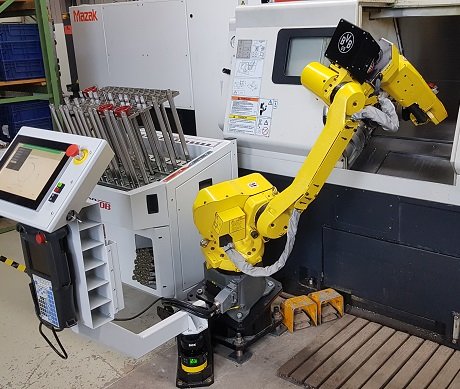
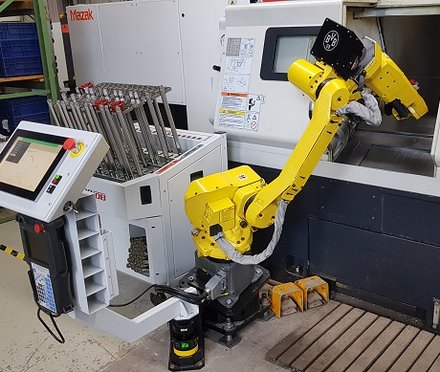
In August 2013, Ackermann’s Mazak QSM 300 was automated with a RoboJob Turn-Assist 180, the first RoboJob installation in Germany. Everything, including the automatic door and interface, was installed in less than a week, and Ackermann could start right away. That first robot ran for years without a single breakdown, and a second Turn-Assist 180 followed on a Mazak QTN 150.
- Mazak QSM 300 with a Turn-Assist 180
- Mazak QTN 150 with a Turn-Assist 180
Automation is in the company’s genes
Automation has become part of Ackermann’s identity, and customers now send requests with the comment that a product is “something for your robot”. The robots run seven days a week, including weekends, which helped Ackermann win orders with very tight delivery times.
The result: 15 to 30% more spindle hours
“On machines with a robot, we easily achieve 15 to 30% more spindle hours than on machines without a robot. Our analyses show that our two robots replace up to 1.5 operators. With the difference that you only have to pay once for this robot and that it pays for itself quickly.”
— Carsten Ackermann
Frequently asked questions
Which machines did Ackermann Metallwaren automate with RoboJob?
Ackermann Metallwaren in Plettenberg, Germany, automated a Mazak QSM 300 and a Mazak QTN 150 with RoboJob Turn-Assist 180 cells. The company has been a RoboJob customer since 2013.
Who was RoboJob’s first customer in Germany?
Ackermann Metallwaren in Plettenberg. In August 2013, its Mazak QSM 300 was automated with a RoboJob Turn-Assist 180, the first RoboJob installation in Germany, installed in less than a week.
Can a Mazak Quick Turn Nexus 150 be automated?
Yes. Ackermann Metallwaren runs a RoboJob Turn-Assist 180 on a Mazak QTN 150. POK and NEXTec+ Fertigungstechnik each automate three Mazak QTN 250 lathes. See all Mazak automation projects.
How many more spindle hours does a robot cell deliver?
At Ackermann Metallwaren, machines with a RoboJob Turn-Assist easily achieve 15 to 30% more spindle hours than machines without a robot. EFM Präzisionstechnik measured 50% more spindle hours with its Mill-Assist cells.
How many operators can a robot cell replace?
Ackermann Metallwaren’s analyses show that its two RoboJob Turn-Assist cells replace up to 1.5 operators. Ackermann uses its people for the tasks that need their skills, while the robots take on batch production, seven days a week.