Takisawa CNC Automation with RoboJob robots

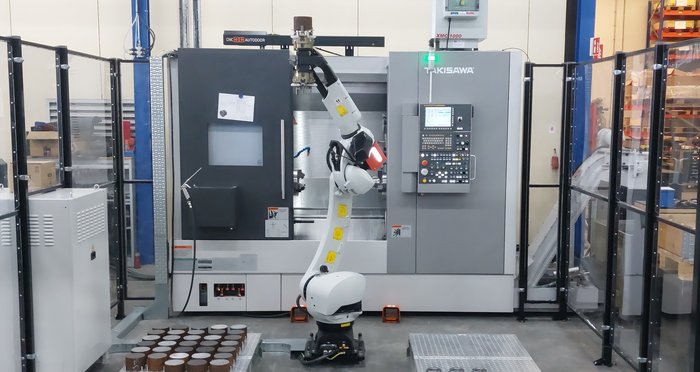
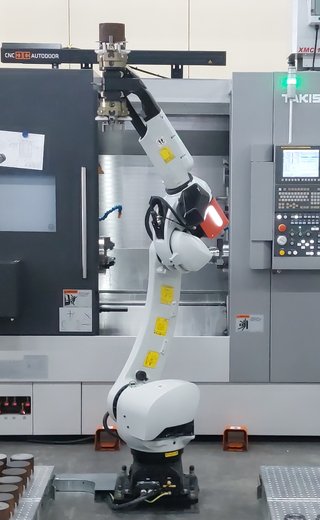
RoboJob automates every type of Takisawa CNC machine with robots that load and unload your workpieces: lathes from this Japanese machine builder, such as the Takisawa TS4000, TS4000YS and TM4000 Y2. That works on the Takisawa you already run and on the new one you are about to buy.
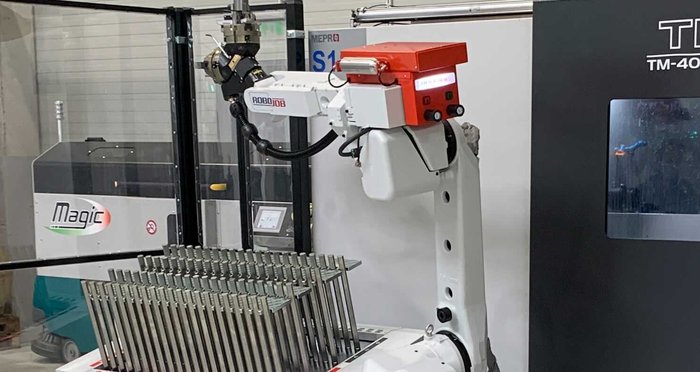
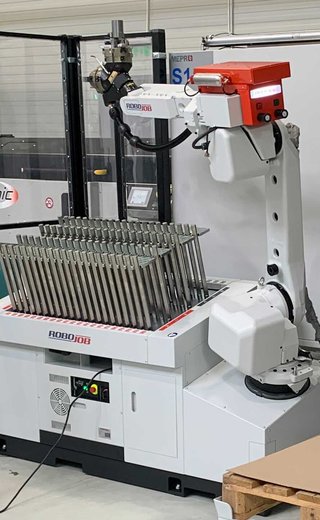
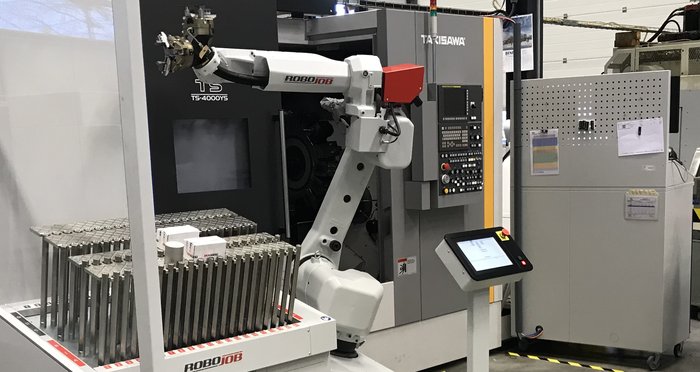
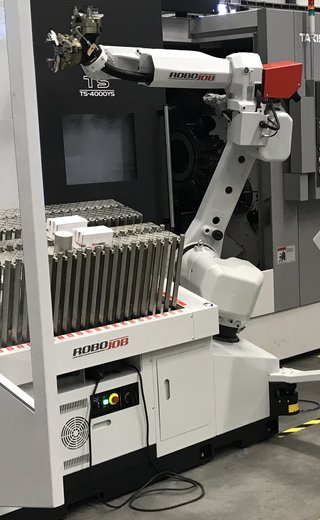
Photos: RoboJob automation on Takisawa machines
How RoboJob automates your Takisawa CNC machine
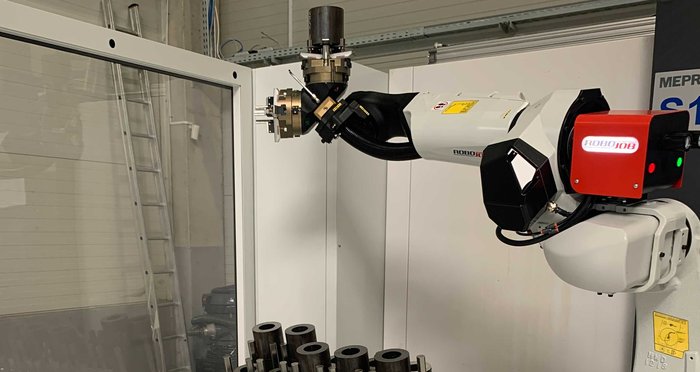
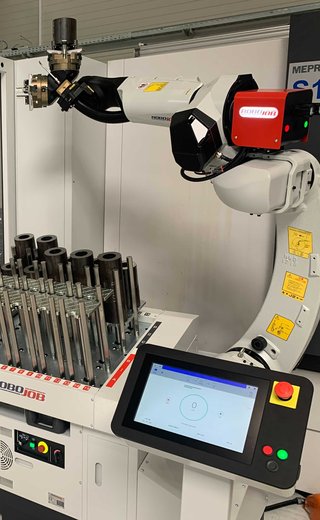
A RoboJob robot takes over the repetitive work at your Takisawa. It picks a raw workpiece, loads it into the chuck, lets the Takisawa machine it and unloads the finished part. Your Takisawa keeps running during breaks, after the shift and at night, while your operators set up the next job, program and check quality.
You set up a new batch yourself in the RoboJob software, in a few minutes and without robot programming. With one click you change the robot speed, the gripping force of the grippers or let the robot grip eccentrically.
RoboJob automates every type of Takisawa CNC machine: TS, TM, TCN and other CNC lathes, twin-spindle and turn-mill lathes, new or existing. Some of the Takisawa models we have already automated:
- Takisawa TS lathes, such as the TS4000 and TS4000YS
- Takisawa TM lathes, such as the TM4000 Y2
Is your model not listed? That does not matter: these are examples, not a limit. Our engineers check whether your Takisawa has an automatic door, automatic workholding and a robot interface, and tell you what is needed if it does not.
Which robot fits your Takisawa lathe?
- Turn-Assist: loads and unloads Takisawa TS and TM lathes, payload up to 70 kg
- Pallet-Load: loads and unloads your Takisawa from pallets, payload up to 165 kg, as on a Takisawa TS4000
- Tower: high-mix production around the clock; swaps workpieces, fixtures, jaws and collets, payload up to 165 kg
- Wall: space-efficient automation that serves several lathes from one system, payload up to 165 kg
- Coby CNC: collaborative robot for a first step into automation, payload up to 10 kg
Not sure which one fits best? Compare all products side by side or take the quick test below.
Get more spindle hours out of your Takisawa
Takisawa users such as Van Trierum Metaalbewerking gain machine capacity after working hours.
Typical payback is 6 to 18 months. Get the brochure, see a RoboJob at work in a demo or request an offer.
Why choose RoboJob for your Takisawa
RoboJob develops and builds standard automation for loading and unloading CNC lathes and milling machines. Since 2007 we have installed more than 2,000 robots in over 30 countries, on more than 100 CNC brands. Because every system is a standard product, you know in advance what you get, and installation is fast.
Headquarters and production are in Heist-op-den-Berg, Belgium, with Technology Centers in Germany and the United States. Our engineers know the robot, your Takisawa and the interface between them, and keep supporting you after installation.
Find the right robot for your Takisawa machine
Answer four quick questions about your Takisawa, your workpieces and your batch sizes, and we suggest the RoboJob that suits you best.
Takisawa users who automated with RoboJob
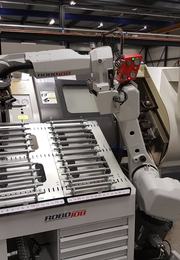
Van Trierum Metaalbewerking runs its Takisawa TS-4000YS unmanned after working hours. Read the story below.
Takisawa users who automated with RoboJob
Van Trierum Metaalbewerking runs its Takisawa TS-4000YS unmanned after working hours. Read the story below.
Frequently asked questions about Takisawa automation
How can I automate my Takisawa CNC machine?
RoboJob offers several proven automation solutions for Takisawa machines and has hands-on experience with the Takisawa TS and TM lathes. A RoboJob robot loads raw workpieces into the chuck and unloads the finished parts, so your Takisawa keeps running during breaks, evenings and nights. The best solution depends on the machine type, your workpieces and your batch sizes. The quick test suggests the right one in four questions.
Which types of Takisawa machines can be automated?
All of them. RoboJob automates every type of Takisawa CNC machine: TS, TM, TCN and other CNC lathes, twin-spindle and turn-mill lathes, on new and existing machines. More broadly, RoboJob automates CNC lathes and milling machines of every brand, including turn-mill centres, multitasking machines and even grinding machines. The models on this page are examples, not a limit: if your Takisawa is not mentioned, RoboJob can still automate it.
How can I automate my Takisawa lathe?
RoboJob offers several solutions for Takisawa lathes and has already automated, among others, the TS4000, TS4000YS and TM4000 Y2. The most suitable solutions for a Takisawa lathe are Turn-Assist, built for loading and unloading lathes with a payload up to 70 kg; Pallet-Load, which loads and unloads from pallets with a payload up to 165 kg; the Tower for high-mix production, which also swaps fixtures, jaws and collets; the Wall, which serves several machines from one space-efficient system; and Coby CNC, a collaborative robot for a first step into automation.
Can I run my Takisawa unattended at night?
Yes. With a RoboJob robot loading and unloading your Takisawa, the machine keeps cutting after the last shift. Van Trierum Metaalbewerking gained machine capacity by running its Takisawa TS-4000YS unmanned after working hours. For unattended nights and weekends with many different parts, the RoboJob Tower offers the most storage and also swaps fixtures.
How much does it cost to automate a Takisawa CNC machine?
The investment depends on the product, your workpieces and the options you need, so RoboJob makes a quote for your specific Takisawa. More telling than the price is the payback: a RoboJob typically pays for itself in 6 to 18 months, depending on how many extra spindle hours the robot adds. The ROI calculation shows it for your own figures, or request your offer directly.
What does a Takisawa machine need before a robot can load it?
A robot-ready Takisawa needs three things: an automatic door, automatic workholding that the control opens and closes (such as a pneumatic vice or a hydraulic chuck) and a robot interface, so the robot and the Takisawa control can exchange signals. If your existing Takisawa lacks one of these, it can usually be retrofitted. RoboJob engineers check your machine and tell you what is needed.
Which Takisawa machines has RoboJob already automated?
RoboJob robots run on, among others, the Takisawa TS4000, TS4000YS and TM4000 Y2 lathes. Takisawa customers include Van Trierum Metaalbewerking in the Netherlands. This is only a selection: RoboJob automates every type of Takisawa machine, so a model that is not listed here can be automated too.
How much more productive does a Takisawa get with a robot?
That depends on how many hours the robot adds. Van Trierum Metaalbewerking gained machine capacity by running its Takisawa TS-4000YS unmanned after working hours. A RoboJob typically pays for itself in 6 to 18 months.
Do I need robot programming skills to automate my Takisawa?
No. With RoboJob you set up a new job in the software with a few clicks, without writing robot programs, so operators set up a new batch within minutes.
How long does it take to install a robot on a Takisawa?
With a standard system such as a RoboJob, installation takes days rather than weeks. The exact time depends on the product and on whether your Takisawa first needs an automatic door or a robot interface. Want to see a RoboJob at work first? Request a demo.
Can one robot serve several Takisawa machines or other CNC brands?
Yes. The RoboJob Wall serves several machines from one system, and RoboJob automates more than 100 CNC brands. A shop with Takisawa machines next to Mazak, DMG Mori or Okuma machines can work with one automation partner for all of them.
Talk to a specialist about automating your Takisawa
Tell us which Takisawa you run and which workpieces you make on it. Our area sales managers know Takisawa machines well and tell you which RoboJob fits and what it can bring you.


Jan Van De Wouwer
Sales Manager

Austin Davis
Area Sales Manager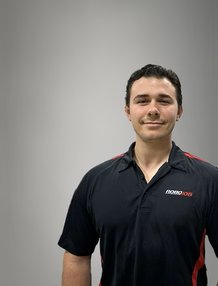

Nathan Miliante
Area Sales ManagerRoboJob automates more than 100 CNC brands
-
Mazak

RoboJob automates every type of Mazak CNC machine, from Integrex multitasking machines and Quick Turn lathes to Mazak machining centres, new or existing.
-
DN Solutions

RoboJob automates every type of DN Solutions and Doosan CNC machine, from Puma and Lynx lathes to DNM, DVF and VC machining centres, new or existing.
-
DMG Mori

RoboJob automates every type of DMG Mori CNC machine, from CTX, CLX and NLX lathes and NTX turn-mill centres to CMX and DMU machining centres, new or existing.
-
Okuma

RoboJob automates every type of Okuma CNC machine, from LB, LT and LU lathes and Multus multitasking machines to Okuma machining centres, new or existing.
-
Emco

RoboJob automates every type of Emco CNC machine, from Maxxturn, Hyperturn and Emcoturn lathes to Emco milling machines, new or existing.
-
Haas

RoboJob automates every type of Haas CNC machine, from VF and UMC milling machines to ST and DS lathes, new or existing.
-
Hedelius

RoboJob automates every type of Hedelius machining centre, from Acura to RS and 5-axis machines, new or existing.
-
Hurco

RoboJob automates every type of Hurco CNC machine, from VMX and VC machining centres to TMX lathes, new or existing.
-
Nakamura-Tome

RoboJob automates every type of Nakamura-Tome CNC machine, from WT and WY lathes to NTY, NTRX and JX multitasking machines, new or existing.
-
Kitamura

RoboJob automates every type of Kitamura machining centre, from the Mycenter series to horizontal and 5-axis machines, new or existing.
-
Hwacheon

RoboJob automates every type of Hwacheon CNC machine, from Hi-TECH lathes to Hwacheon machining centres, new or existing.
-
Brother

RoboJob automates every type of Brother Speedio machine, from S, R and TC machining centres to 5-axis and mill-turn machines, new or existing.