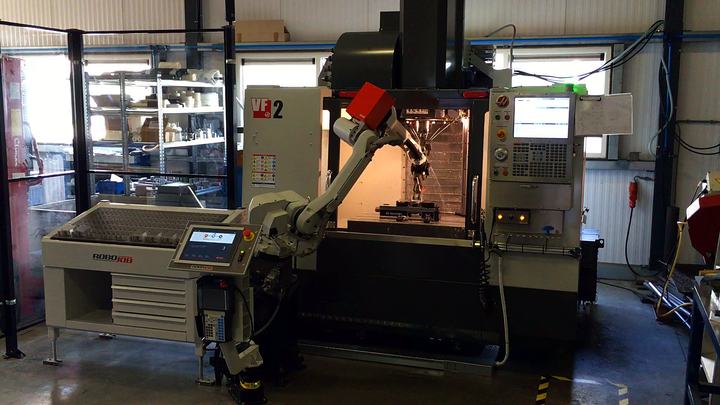
Paricla automates a Haas VF-2 with a RoboJob Mill-Assist Essential
From 6 to 16 spindle hours a day, and two extra jobs
Paricla automates a Haas VF-2 with a RoboJob Mill-Assist Essential
Paricla Fijnmechanische Techniek in Stadskanaal, the Netherlands, machines parts from single pieces to series. Since 2016, a RoboJob Mill-Assist Essential has automated its Haas VF-2, raising spindle hours from 5.5–6 to 16 a day. And instead of costing jobs, automation created them: the team grew from four to six people.
Key facts
- Company: Paricla Fijnmechanische Techniek
- Location: Stadskanaal, Groningen, the Netherlands
- Founded: 1998
- Employees: approx. 8
- Industries: Subcontracting
- RoboJob products: Mill-Assist Essential
- CNC machine brands: Haas
- Automated machines: Haas VF-2
- RoboJob customer since: 2016
- Key results: from 5.5–6 to 16 spindle hours a day; 96 parts ready after one night; staff grew from 4 to 6 after automating
A family business with a clear vision
Wolter and Tinie van den Broek founded Paricla in 1998, after two years of developing a vision and strategy. The name comes from the first letters of their three children’s names: Patrick, Ricardo and Claudia. Starting with conventional machines, Paricla soon moved to CNC, kept expanding its machine park and moved to new premises in Stadskanaal in 2009. Continuous improvement, innovation and investment remain its guiding principles.
Why automate: spindle hours and skilled people
“You just have to take that route if you want to retain a market share in the Netherlands. This has to do with spindle hours and efficiency: without automation we attain 5.5 to a maximum of 6 hours per day. In order to remain competitive, we have to increase the spindle hours and efficiency. It is also very difficult to find good workers in the Netherlands.”
— Wolter and Tinie van den Broek, Owners, Paricla
Paricla discussed automation openly with its employees. When they asked whether a robot would take their jobs, the answer was clear: the aim was to change the way of working and get the process fully under control.
Why RoboJob: simple, and one robot per machine
After searching online and visiting the Techni-Show, Paricla met several providers and visited RoboJob’s showroom in Heist-op-den-Berg. The ease of use of the Mill-Assist Essential was convincing.
“What we didn’t want was 1 robot between 2 machines. If we did that we’d have to make concessions on flexibility. We wanted 1 robot on 1 machine, so that we could still keep 2 machines free, which we wanted keep deploying flexibly.”
— Wolter and Tinie van den Broek
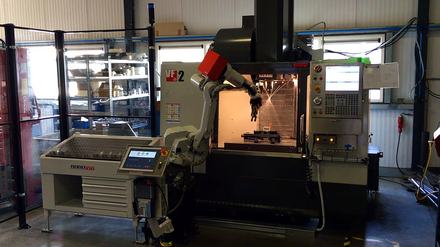
A Mill-Assist Essential on a Haas VF-2
The Mill-Assist Essential was installed on Paricla’s Haas VF-2 vertical machining centre. Thanks to RoboJob’s good contacts with Haas, the installation went perfectly.
The result: 16 spindle hours and two new jobs
“Using RoboJob automation we are now at a whopping 16 spindle hours a day. We now engage our robot also at night and during the weekend. Last night, the Mill-Assist continued working and this morning there were 96 products ready. It turns out to be a very simple solution to increase our spindle hours.”
— Wolter and Tinie van den Broek
“Plus we’ve shown that thanks to automation, we’re not scrapping any jobs, but creating new jobs. At the time we bought our robot, we had 4 employees. Now we have 6.”
— Wolter and Tinie van den Broek
Frequently asked questions
Which machine did Paricla automate with RoboJob?
Paricla Fijnmechanische Techniek in Stadskanaal, the Netherlands, automated a Haas VF-2 vertical machining centre with a RoboJob Mill-Assist Essential. The company has been a RoboJob customer since 2016.
Can a Haas VF-2 be automated?
Yes. Paricla runs a RoboJob Mill-Assist Essential on a Haas VF-2. EFM Präzisionstechnik automates two VF-2 machines and a VF-4, and Bopla a VF-2SS. See the Haas automation page.
How many spindle hours a day can a robot cell deliver?
At Paricla, the Haas VF-2 went from 5.5 to at most 6 spindle hours a day without automation to 16 spindle hours a day with a RoboJob Mill-Assist, running at night and at weekends. After one night, 96 parts were ready.
Does automation cost jobs?
Not at Paricla. When it bought its RoboJob Mill-Assist, Paricla had four employees; afterwards it had six. Automation freed up resources to invest in more capacity and machines.
Should one robot serve one machine or two?
It depends on your priorities. Paricla deliberately chose one robot per machine, so its other machines stay free for flexible use. De Craecker Matrijzen once had a robot shuttle between two lathes.