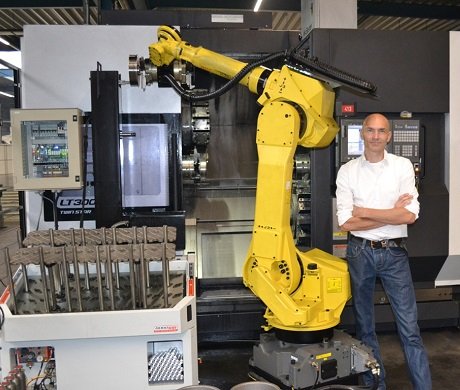
Bies Venray automates five Okuma lathes with RoboJob Turn-Assist 250
Product-independent automation, programmed parametrically
Bies Venray automates five Okuma lathes with RoboJob Turn-Assist 250
Bies Venray, formerly known as MMI (Machine-Metaal-Industrie), is a precision machining supplier in Venray, the Netherlands. Since 2012, RoboJob has automated five of its Okuma lathes with Turn-Assist 250 cells, chosen for their flexibility and parametric programming. The result: consistent quality, more flexibility and minimal cycle times.
Key facts
- Company: Bies Venray (formerly Machine-Metaal-Industrie, MMI)
- Location: Venray, Limburg, the Netherlands
- Founded: 1948
- Employees: approx. 120
- Industries: Subcontracting
- RoboJob products: Turn-Assist 250 (5×)
- CNC machine brands: Okuma
- Automated machines: Okuma LU-15M, Okuma LR-25, Okuma LT-3000 EX (2×), Okuma LU-3000 EX
- RoboJob customer since: 2012
- Key results: five Okuma lathes automated; quality maintained and flexibility increased; cycle times reduced to a minimum
Precision machining in Venray since 1948
Founded in 1948 as Machine-Metaal-Industrie (MMI), the company has continued as Bies Venray since 2022. It machines a wide range of materials, from various steels to aluminium, copper, brass and plastics, for customers in sectors such as automotive, transport and electronics. Quality and flexibility have always been its strengths, which made it an early adopter of automation.
Why automate: staying competitive
“The high cost of personnel in the Netherlands means that automation is an obvious choice. If as a company, you want to remain competitive with the cheaper countries, then you just have to work efficiently. In that context we took up our quest for automation some years ago.”
— Bies Venray (formerly MMI)
Why RoboJob: flexible and product-independent
“We knew RoboJob already but of course also made the comparison with other providers. What appealed to us enormously with RoboJob was the flexibility of their automation, plus the ease with which you can program parametrically. If you choose to automate, then of course you want a solution that is product independent. That’s why we selected RoboJob. We have worked together quite a lot on development and that’s when you quickly notice that these people know what they’re talking about.”
— Bies Venray (formerly MMI)
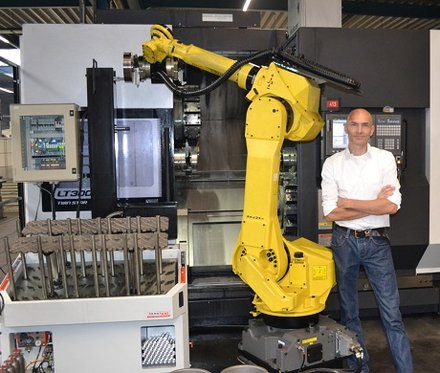
Five Turn-Assist 250 cells on Okuma lathes
In 2012, the first RoboJob Turn-Assist 250 was installed on an Okuma LU-15M, soon followed by a second on an Okuma LR-25. Because the Turn-Assist met the requirements for quality, flexibility and simplicity, three more followed just over a year later.
- Okuma LU-15M with a Turn-Assist 250
- Okuma LR-25 with a Turn-Assist 250
- Okuma LT-3000 EX with a Turn-Assist 250
- Okuma LT-3000 EX with a Turn-Assist 250
- Okuma LU-3000 EX with a Turn-Assist 250
The result: quality, flexibility, short cycle times
With RoboJob, Bies Venray kept its quality high, increased its flexibility and reduced cycle times to a minimum. The employees were open to the change from the start and saw it as a new challenge in their work.
“Meanwhile, our robots are fully integrated into the workplace and we continue to work on optimizing our organization.”
— Bies Venray (formerly MMI)
Frequently asked questions
Which machines did Bies Venray automate with RoboJob?
Bies Venray in Venray, the Netherlands, runs five RoboJob Turn-Assist 250 cells on Okuma lathes: an LU-15M, an LR-25, two LT-3000 EX and an LU-3000 EX. The company has been a RoboJob customer since 2012.
Is Bies Venray the same company as MMI?
Yes. Machine-Metaal-Industrie (MMI) in Venray, founded in 1948, has continued under the name Bies Venray since 2022. Its RoboJob cells, first installed when the company was still called MMI, are still in use.
Can Okuma lathes be automated?
Yes. Bies Venray runs RoboJob Turn-Assist 250 cells on five Okuma lathes. HP Valves and Stubbe Metaalbewerking also automate Okuma lathes. See all Okuma automation projects.
What is parametric programming of a robot cell?
With RoboJob, new parts are set up by entering parameters such as dimensions, instead of teaching the robot each movement. Bies Venray chose RoboJob for this ease of programming, which makes the automation product-independent.
Can you start with one robot cell and expand later?
Yes. Bies Venray started in 2012 with a Turn-Assist 250 on an Okuma LU-15M and a second on an LR-25. Once the cells proved themselves, three more followed just over a year later, bringing the total to five.