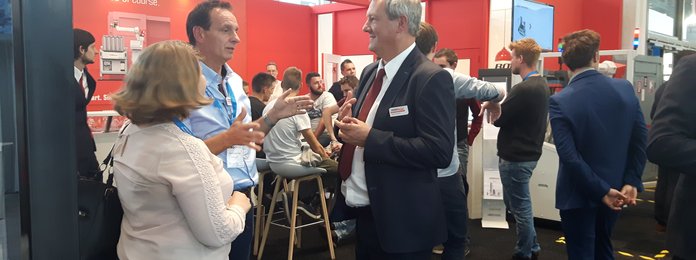
Looking back on the past 25 years with Helmut De Roovere, CEO RoboJob
How did RoboJob grow from one robot in a corner to an international CNC Automation company?
What began in the 1990s with a robot gathering dust in a corner has grown into an international company with Technology Centres in Germany and the United States, and now a brand-new headquarters in Heist-op-den-Berg, Belgium. The driving force behind that journey is Helmut De Roovere. Faced with a growing shortage of CNC operators at his own company, Aluro CNC, he realised that a robot alone was not the answer. Together with software specialist Luc De Ceuster, he set out to build a complete automation solution that anyone could operate, even without any robot knowledge. As RoboJob settles into its new home, we sat down with Helmut to look back on 25 years of RoboJob, from the very first Turn-Assist to international growth, and on why automation matters more than ever in today’s fluctuating market.
RoboJob has just moved to new headquarters in Heist-op-den-Berg (Belgium), a major milestone. How did it all start?
Helmut: “For the start of RoboJob, I need to go all the way back to the 1990s. That’s when I bought my first robot, because I was convinced that robotisation would become a necessity in machining. To be perfectly honest, that robot sat in a corner for many years. After all, I simply didn’t have time for it: I was fully occupied with the day-to-day management of Aluro CNC, a supplier of turning and milling work. I was also involved in developing the Aluroller for sister company Aluro Machine Construction, and I went on to install that machine abroad. I was 25 years younger than today, and brimming with energy. So all that went well. But that robot, well, it stayed in that same corner.”
So when did you start working on it?
Helmut: “In 2005, I went back to focusing fully on Aluro CNC, and there I was confronted with a harsh reality: even then, it was clear that there was an increasing shortage of CNC operators. I even started looking for them abroad, but that is not a structural solution for this shortage. At that moment, I realised that I had to get back to the robot. In 2006, I went on a course at FANUC, where I learned to work with FANUC’s ‘Teach Pendant’, just like many others. This is a kind of remote control on which you have to programme all the robot’s movements. I can assure you: it’s absolutely necessary to take such a course if you want to work with a robot. This is how I came to realise that the software would be crucial: you have to make programming a robot as simple as possible, so that someone without robot knowledge can also work with it.”
And that’s when Luc came into the picture?
Helmut: “Indeed. I have known Luc De Ceuster since my student days. Whereas my background is rather mechanical, Luc specialises in software programming. In fact, he also spent 20 years developing and perfecting the software for Aluro’s Aluroroller. After the course at FANUC, I understood that a robot by itself would not be a solution. For small and medium-sized batches, a robot can only be used if you can operate it easily and quickly. Software is therefore crucial.
A robot as such is too generic and not user-friendly enough for any particular market. Take welding robots, for example: every manufacturer of welding robots offers its products with its own software, regardless of which brand of robot they work with. You see the same with palletising robots. Software turns out to be crucial for every application of robots.”

So a robot with user-friendly software. Yet a RoboJob product looks very different today?
Helmut: “If you look at RoboJob’s products today, you do indeed see more than just a robot with user-friendly software. You see compact tables, which you can configure to the dimensions of your workpieces. You see a Tower with trays, you see configurable pallets. And don’t forget flexible grippers, safety and so on. It’s the combination of all those elements that makes it a product.”
How do you make something so complex easy and intuitive for the user?
Helmut: “I like to compare it with a car: the engine is crucial, otherwise you won’t get anywhere. But it’s everything around the engine that makes it a car: the bodywork, the steering wheel, the seats and so on. The whole concept of the car makes it possible for someone with no knowledge of engines to get from A to B very comfortably. That was also our intention with RoboJob: even someone who knows nothing about robots should be able to work with them very comfortably. To this end, we needed to develop a product in which we built all the missing elements to arrive at a user-friendly and easy-to-set-up robot cell. The user-friendly software was one of the elements to be developed.
An additional advantage of the product approach is that you can ensure that the same solution works for different companies. That way, you can further develop that solution, no matter which machine it will be on.”
Fast-forward to 2010, when you installed the first Turn-Assist at Aluro CNC. How did that go?
Helmut: “The Turn-Assist was our first product, our first ‘baby’. It’s still there, by the way. And it is still being used every day!”
Is that when the ball got rolling?
Helmut: “If only it were that easy! In April 2011, we organised a press event to which the trade press was invited. That way, we were able to make RoboJob and the Turn-Assist known. But that was just the beginning. From then on, we had to keep investing in marketing and had to go out on the road to sell.”
How important were those first customers to RoboJob?
Helmut: “The first customers came that same year, in 2011. These were companies similar to Aluro CNC, with similar challenges and problems.
We gained a lot of trust from these companies, and I am still very grateful to them. Luc and I installed the first systems ourselves and learned a lot from that.
But what we also immediately got from these first customers was their user experience: these people started using our product on a daily basis, and if you listen carefully to them, you can keep improving your product. This is called ‘incremental innovation’. It is something we still apply today: we still collect feedback, via installers and our Service department, among others. We are constantly asking ourselves how we can make our product even better and how we can solve our customers’ challenges.”
Many people confuse today's economic climate with a crisis, but it is actually not. We are actually back to normal as we were before Covid. Very busy periods alternate with very calm periods. And that cannot always be resolved with staff.
RoboJob quickly crossed national borders, with Technology Centres in Germany and the US. How important is that for RoboJob?
Helmut: “The Netherlands and Germany did indeed follow quickly. We can serve the Netherlands perfectly from Belgium, but Germany is a bit different. Together with FIT (Flanders Investment & Trade), we studied in detail where the largest industrial regions in Europe and North America are. For example, southern Germany turns out to be a major industrial region, located at a crossroads of motorways. And it is also a region that is rather far from Belgium: a logical choice, therefore, to set up there and anchor ourselves strategically.
The same goes for the United States. If there is one country that can, and does, move fast, it is the USA. You see massive efforts there today to bring back entire industries, backed by strong government policies. You can call it ‘patriotism’: ‘we are going to bring work back to the US by any means necessary’. That’s the mentality there. But how are you going to do that without automation? Because there, too, there is a shortage of CNC operators. That’s why it’s hugely important to be anchored there too.
So Germany and the USA are two strategic markets for us, but I imagine we will do the same in countries like France in the future.”
Covid did change some things. How do you look back on that?
Helmut: “Covid was a short-lived accelerator for our industry. During that period, we received a lot of confirmation and gratitude from our customers who already had a robot. After all, they could continue production even during a lockdown. The added value of CNC Automation became clear then, and during Covid there was a high acceptance of automation.
Covid, incidentally, badly disrupted the supply chain. Many companies were barely able to produce, leaving stocks depleted and barely replenished.
That, and a ship that went sideways in the Suez Canal, caused major shortages after Covid. So during that period, there was a lot of ordering and production for a short period of time. It was almost the same situation as in the 1980s and 1990s: a lot was produced in large quantities to replenish stocks. The typical fluctuations in the supply chain were gone.
Today, you can see that that period is behind us. The big shortages have been replenished, so the typical fluctuations of the supply chain are back: there are very strong fluctuations in demand, and those fluctuations become more pronounced as you move down the supply chain, the characteristic bullwhip effect. It is suppliers that feel those fluctuations the most. Specifically, this means that suppliers are either very busy or have hardly any work.”
Why does automation matter more than ever in today’s market?
Helmut: “Many people confuse this with a crisis, but it is actually not. We are actually back to normal, as we were before Covid. Very busy periods alternate with very calm periods. And that cannot always be accommodated with staff. Right now, the added value of robotisation is at its highest: a manufacturing company has to provide for minimum staffing levels, and peaks have to be met with automation.”
Frequently asked questions about the history of RoboJob
Who founded RoboJob?
RoboJob was founded by Helmut De Roovere, who has a mechanical background, and software specialist Luc De Ceuster. Helmut is RoboJob’s CEO.
Why was RoboJob founded?
At his company Aluro CNC, Helmut De Roovere faced a growing shortage of CNC operators. He realised that a robot alone was not the answer, so together with Luc De Ceuster he built a complete automation solution that anyone can operate, even without robot knowledge.
What was RoboJob’s first product?
RoboJob’s first product was the Turn-Assist. The first one was installed at Aluro CNC in 2010 and is still used every day.
Where is RoboJob located?
RoboJob has its headquarters in Heist-op-den-Berg, Belgium, and Technology Centres in Germany and the United States.
Why is CNC Automation so valuable in today’s market?
Demand fluctuates strongly, especially for suppliers: very busy periods alternate with very calm ones. Companies cannot always absorb those peaks with staff, so they keep minimum staffing levels and meet the peaks with automation.